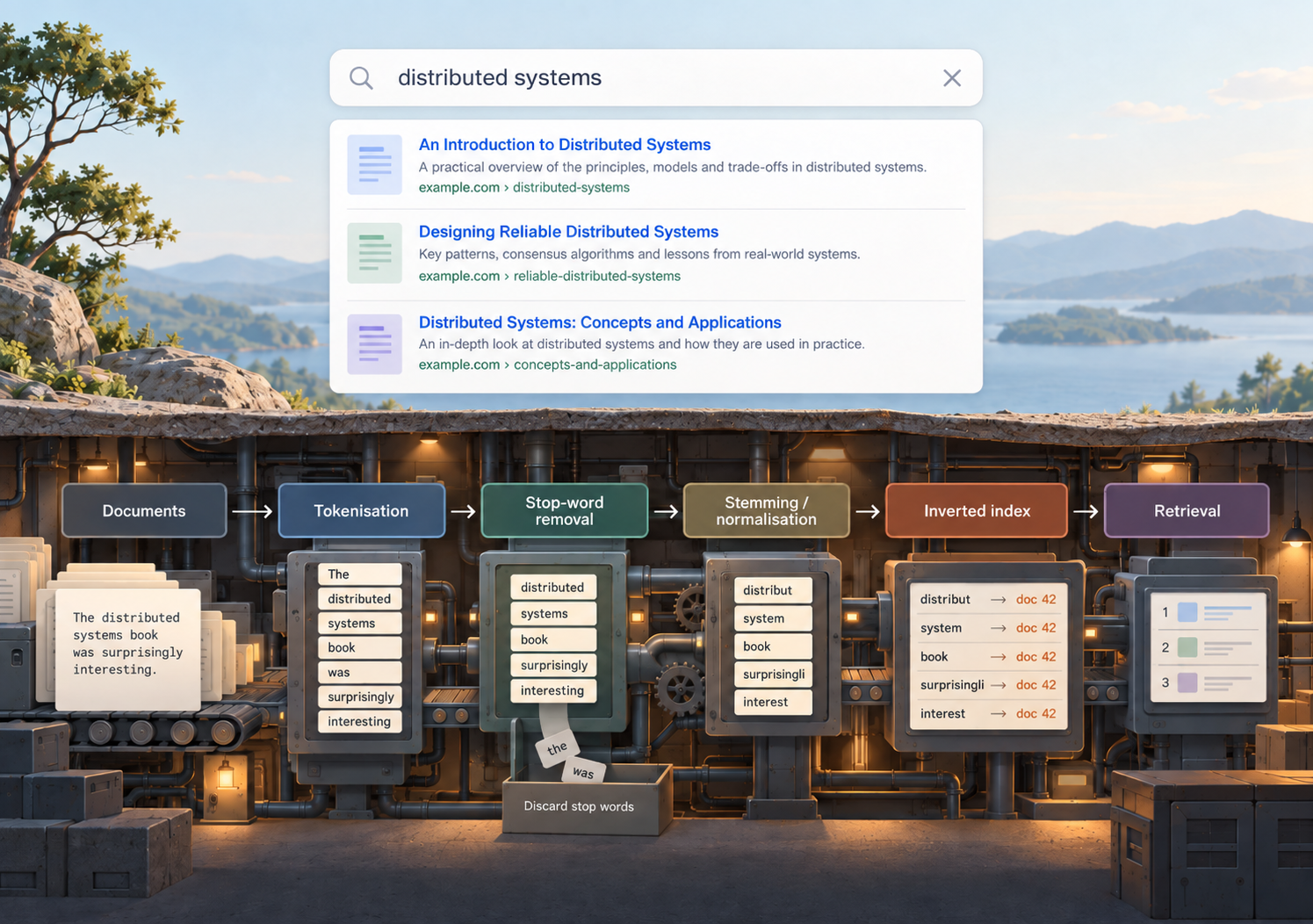
The Index Is a Bet You Made at Write Time
Search feels instantaneous. We type a few words and hit enter. Millions of documents collapse into a neat list of results in less than a second. It gives the illusion of a system that heard your reque
This blog explores how systems behave beyond the happy path, where assumptions are tested, trade-offs become visible, and failures are often inevitable.
Most pieces focus on distributed systems, data systems, and the constraints that shape them in production.
The goal isn't just to explain how things work, but to build mental models, examine failure scenarios, & understand the decisions real systems force you to make.
This is not a tutorial blog. It’s a place to think through complex systems.
Search feels instantaneous. We type a few words and hit enter. Millions of documents collapse into a neat list of results in less than a second. It gives the illusion of a system that heard your reque
Part 4: How reality forces us to bring time back

Part 3: How distributed systems track causality

Part 2: If timestamps lie, what actually determines order?

Part 1: Why timestamps lie and ordering events isn’t as simple as it looks

Transactions Before we look into distributed transactions, it is important we understand transactions. What is a transaction? A transaction is a set of operations executed as a single, indivisible unit of work on a database ensuring ACID (Atomicity, ...
Introduction Database Management Systems (DBMS) use different storage structures to organise and access data. Three of the most popular storage structures are Heap-Organised Tables, Hash-Organised Tables, and Index-Organised Tables. In this post, we’...
Understanding the basics of string matching